
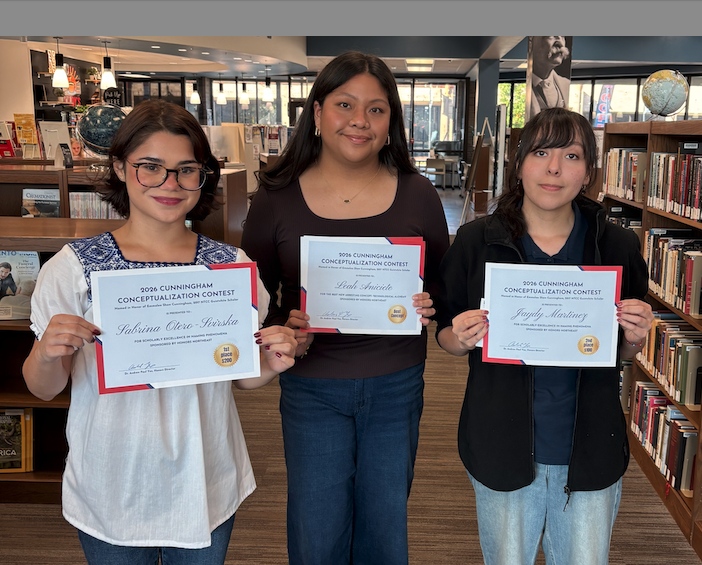
Winners included (from left): Sabrina Otero-Svirska, Leah Aniciete, and Jaydy Michelle Martinez.
By: Dr. Andrew Yox, Honors Director
For over a decade, the students of the “BioTex” honors seminar at NTCC have experienced a November “email shootout.” This is something like a cross between an ongoing basketball game with scores changing in real time, and a fast-paced, scholarly-poetic thinkathon. The course challenges students to conceptualize the elements of their Texas history research essays, to utilize crossover “analogs, (terms)” particularly from biology and other scientific fields, and to provide terse definitions of newly minted concepts.
This year, Sabrina Otero-Svirska bested all others, winning $200. The first-year winner of both the poetry contest, and the Stevenson awards for acting, Otero-Svirska made twenty-nine attempts to score in the eighty-minute period--a record for the series--and scored fifty-three points. She coined and defined an interrelated conceptual field for her research on “Tejano Culture from Lydia to Selena: the Rise of a Celebratory Innenwelt.” According to Otero-Sviska, there “two queens” of Tejano music that marked the 20th century, Lydia Mendoza, and Selena Quintanilla. Each developed their own extensive “cultural cartography,” both left a musical archive, that is periodically “reanimated” by fans, and cover singers, and both shared struggles with a genre that had traditionally been dominated by males, as well as a handful of well-placed urban promoters. But the commonalities soon disappear when one compares the styles and content of their songs. Mendoza represented a “matrilineal culture” of misgiving—with males, politics, and poverty. Quintanilla, however, “kineticized” Tejano culture, replacing the ballad with the dance. The second queen integrated males into her music, avoided political stigmas, and “successfully commercialized” her significance, catalyzing visual emblems of group pride.
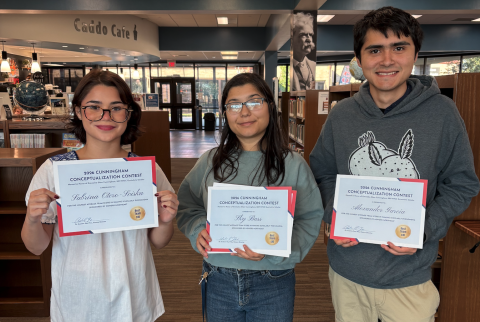
NTCC’s James and Elizabeth Whatley Scholar, Jaydy Michelle Martinez came in second and won $100. Her topic about the “polycurative tradition” in Texas examines the successes and failures of a trichotomous medical presence in nineteenth -century Texas—one followed by native Americans, the curanderismo tradition of Mexican Americans, and the more invasive, avant-garde Anglo techniques. Her essay explores the potential of “medical pluralism.” The “botanical juxtaposition” of herbs to illnesses necessitates an “inter-ethnic scorecard” more than sweeping arguments about better approaches. Moreover, the “spirit versus scalpal” arguments of the era were more balanced. Amazingly there is no record of out-of-state patients coming to the famous Dr. Ashbel Smith of Texas, but there were patients who came from as far away as New York to be healed by the noted curandero, Don Pedro Paramillo.
Leah Aniciete came in third, winning $50. She posits a controversial “Golden Age” of Texas business not during the oil boom of the 1930s and 1940s, or the “Age of Elon Musk,” but during the period, 1970-2000. It was during the late-twentieth century according to Aniciete that a series of native-born Texans made a series of “promethean innovations” in-state, and without the direct aid of the state’s natural resources. Mary Kay created a “pink pathway,” a corporation made to accommodate married women, with a culture designed to offset the more invasive, family-destroying aspects of capitalism. Michael Dell embraced a philosophy of “unimpeded consumerism,” eliminating middlemen, and aiming to target the unique profile of specs desired by individuals. Compared to previous oil field discoveries, George Mitchell engaged in a kind of “technological alchemy,” which through fracking converted barren shale to windfall of black-gold profits.
There was again this year, a single best concept prize given to Aniciete, for “technological alchemy.” There were also a fourth-place $10 prize for Sky Bass whose work on “Fraudporations” is reevaluating the place of the Enron disaster in the light of the stories of other swindler corporations. Finally, there was a team prize conferred to Otero-Svirska, Bass, and Alexander Garcia for the best per-person score.
Honors Director and Texas history professor Dr. Andrew Yox notes that “conceptualization is the key to writing an original, coherent essay, animated by a creative argument. It also is the key to writing conference-accepting abstracts. Finally, the state of Texas gives us a general encouragement for conceptual breakthroughs as the number-one goal of our history classes is to form a creative argument. In any case, I am very thankful for our honors donors for incentivizing our quest for a superior conceptualization. I am also thankful for the whole institutional setting here that has inspirited such exemplary levels of scholarly poetry as is seen already in the works of Otero-Svirska, Martinez, and Aniciete.”
The Cunningham Conceptualization Awards receive their name from Emmalea (Shaw) Cunningham who as a Texas Heritage National Bank Scholar at NTCC won a Guistwhite Award, and published the essay, “Blind to Brown,” the story of how Northeast Texas came to accept federal mandates to integrate their schools in the 1970s. It was also a highly conceptualized, award-winning article. Cunningham also became the first of the NTCC honors alumni to donate a significant amount to Honors Northeast. Her parents, Lori and Ron Shaw have also given generous donations to NTCC’s honors program. After receiving her doctorate, Emmalea is now a licensed therapist, married and a mother of two. She and her husband reside in Liberty Hill, Texas, a fast-growing exurb, northwest of Austin.
Of the top individual winners, Otero-Svirska, and Martinez are 2026 graduates of Mount Pleasant High School. Leah Aniciete is the current number-one ranked student in the senior class at Chapel Hill High School.